
EDUDER promotes alliances and strategies for university inclusion in Latin America at two major events held in Antigua Guatemala
Antigua Guatemala, Guatemala, 27, November
Between November 24 and 27, the city of Antigua Guatemala (Guatemala) hosted two high-impact regional scientific events: the II Global Meeting of the Erasmus+ EDUDER Project (No. 101129036) and the IV Ibero-American Congress on Education in Human Rights, consolidating a joint work space around educational inclusion and equal opportunities in Ibero-America.
Progress of the Eduder Project: more than 400 students mentored and new intervention models
The global meeting brought together 19 universities from 9 countries, who presented their intervention plans to improve equal access to and retention in higher education for the most vulnerable groups. (https://eduder.org).
These plans have made it possible to mentor more than 400 students through support and monitoring programs, identify existing but little-visible university services to strengthen their internal communication, and detect the need for new institutional strategies and structures that help eliminate barriers to access or factors that cause academic dropout.
The commitment of the teaching staff and students was one of the most valued elements, along with the climate of trust and collaboration generated between the institutions. The overall result reflects a high level of satisfaction and anticipates the projection of a future EDUDER 2 to continue the work started.
The IV Ibero-American Congress on Human Rights Education: towards universities more committed to their environment
In parallel, the IV Congreso Iberoamericano en Derechos Humanos was held, under the theme “Social Vulnerability in Ibero-America: Intervention Models for Inclusion and Social Coexistence. Challenges and Opportunities.”
The main objective was to discuss the project’s progress with external experts and to design strategies for its continuation. Key findings include:
- The need to formulate new organizational structures in universities that allow the consolidation and institutionalization of the implemented strategies.
- A critical analysis of the current functioning of Ibero-American networks and proposals for improvement to strengthen their impact.
- The drive towards engaged universities, more committed to their social environment and capable of generating sustainable responses to the challenges of vulnerability.
As a result of the coordinated work in the Chair Networks, three collaboration agreements were signed with key entities in the defense of human rights:
- Federación Iberoamericana del Ombudsperson (FIO).
- Red de Instituciones Nacionales para la Promoción y Protección de los Derechos Humanos del Continente Americano (RINDHCA).
- Unión de Universidades de América Latina y el Caribe (UDUALC).
Both events concluded with an act of support and advocacy for Mayan universities, highlighting the need for their recognition and institutional support within the Ibero-American higher education system.
Access to press release
Contact us: eduder.ucjc@ucjc.edu
Fotografías del evento:
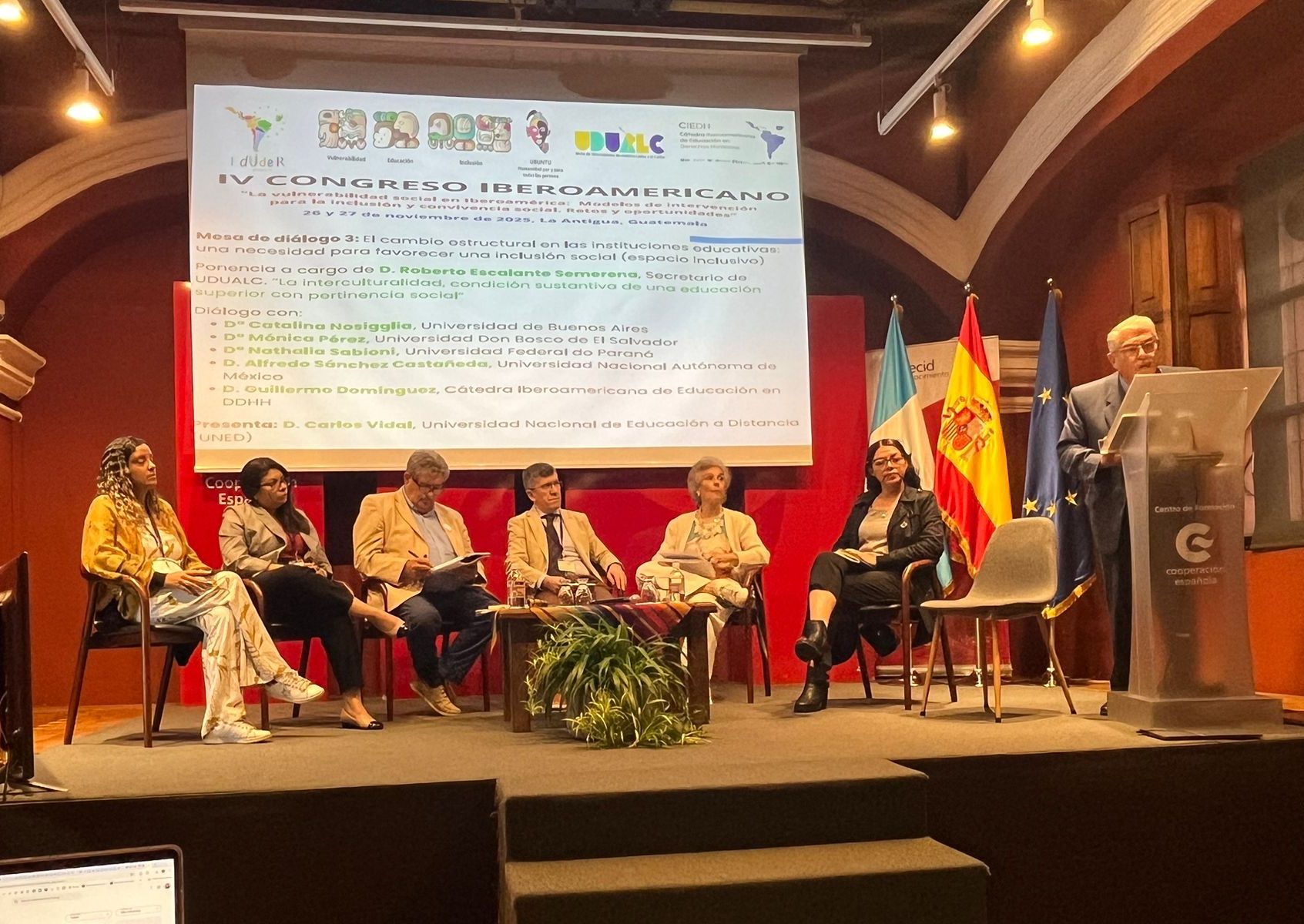
Dialogue table 3 del IV Congreso Iberoamericano: Catalina Nosiglia (Universidad de Buenos Aires), Mónica Pérez (Universidad Don Bosco de El Salvador), Nathalia Sabioni (Universidad Federal do Paraná), Noemí Monroy (Universidad Nacional Autónoma de México) y Guillermo Domínguez (Cátedra Iberoamericana de Educación en DDHH).
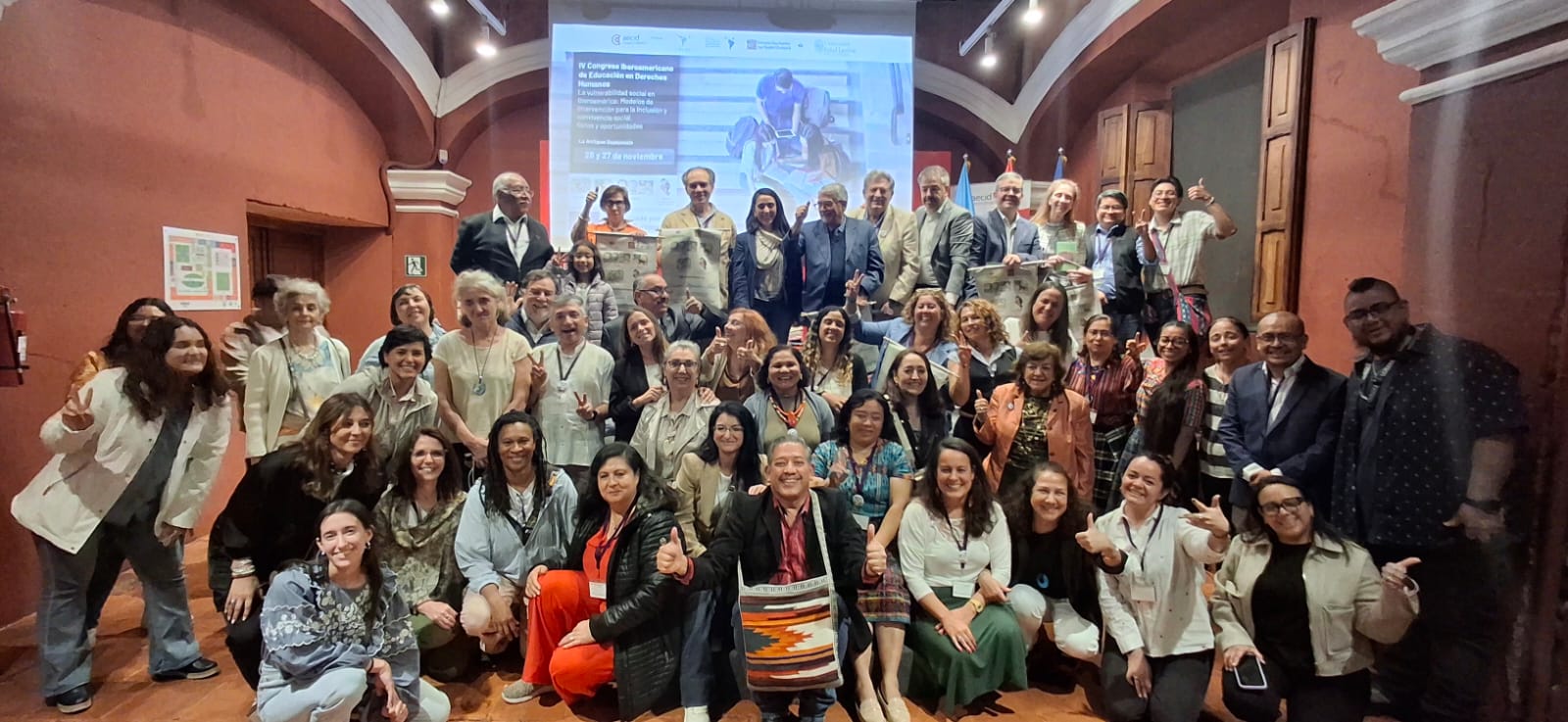
Closing act 27/11/2025.